AEO for Plumbers: How to Show Up in ChatGPT and Google AI in 2026
What if a homeowner in your service area asked ChatGPT or Google AI to recommend a plumber—and your strongest competitor appeared while your company was never mentioned?
That risk is growing as customers ask detailed questions such as, “Who is the best emergency plumber near me?” AI systems can compare businesses, summarize services and cite sources before a homeowner visits a website. If your company is difficult to understand or verify online, excellent workmanship alone will not make it visible.
This guide explains AEO for plumbers, how AI search works, which signals matter, what to optimize and how to measure results. You will also get a practical 90-day plumber AI SEO plan and a complete implementation checklist.
Quick answer: AEO for plumbers is the process of making a plumbing company’s information easy for search engines and AI systems to find, understand, verify and cite. It combines sound SEO, detailed service content, local relevance, accurate business information, reviews, technical accessibility and credible mentions across the web.
What Is AEO for Plumbers?
AEO means Answer Engine Optimization. It helps your business become a useful and trustworthy source when platforms generate direct answers instead of displaying only a list of links.
For a plumbing company, AEO may help the business appear when someone asks:
- Who is the best emergency plumber near me?
- Which plumber repairs tankless water heaters in my city?
- What does hydro jetting cost?
- Is trenchless sewer repair worth it?
- Which local plumbing company offers financing?
- Who can repair a burst pipe tonight?
AEO does not involve submitting a list of preferred answers to ChatGPT or Google. It means publishing accurate information and strengthening the web signals that allow an answer engine to identify your company, understand what it does and confirm claims through other sources.
The best AI SEO for plumbers therefore begins with the same foundation as effective plumber SEO: a crawlable website, useful pages, strong local signals, real expertise and a reputation that can be independently verified.
AEO vs. SEO vs. GEO: What Is the Difference?
The three terms overlap, but they describe different outcomes. Plumbing companies should not abandon SEO to chase a new acronym because AI search still relies heavily on discoverable web content.
| Strategy | Primary objective | Example outcome for a plumber | Important signals |
|---|---|---|---|
| SEO | Rank pages in traditional search results | A drain-cleaning page ranks for “drain cleaning in San Diego” | Relevance, links, technical SEO, helpful content and page experience |
| Local SEO | Appear in local and map-based results | The company appears in Google Maps for an emergency plumbing search | Google Business Profile, proximity, relevance, reviews, prominence and local consistency |
| AEO | Become a clear answer or cited source | Google AI cites the company’s water-heater guide | Direct answers, evidence, structure, authority and crawlability |
| GEO | Earn visibility in generative AI responses | ChatGPT or another AI platform mentions or cites the business | Search visibility, entity clarity, corroborating sources and content usefulness |
In practice, plumber AI SEO, AEO and generative engine optimization work together. FlowLead’s guide to plumber SEO, AEO and GEO explains the broader relationship, while this article focuses on the steps required to compete in AI-generated answers.
How Google AI and ChatGPT Find Plumbing Information
AI systems do not all use the same index, ranking systems or source-selection process. Their answers can also change with the wording of a question, the user’s location, current web results and the sources available at that moment.
How Google AI finds sources
Google states that AI Overviews and AI Mode are grounded in its core Search ranking and quality systems. Google may use a “query fan-out” process that runs several related searches across subtopics and data sources before building an answer.
For example, a detailed request for an emergency plumber could cause Google to consider several needs:
- The plumbing service required.
- The homeowner’s location.
- Whether the business offers emergency service.
- Reputation and evidence of trust.
- Information that helps the homeowner compare options.
According to Google Search Central’s guidance for AI features, a page must be indexed and eligible to appear with a standard Google Search snippet before it can appear as a supporting link in AI Overviews or AI Mode. There is no separate application or guaranteed placement.
How ChatGPT finds sources
ChatGPT Search can retrieve current information from the web and show links to its sources. OpenAI says any website or publisher can choose to appear in ChatGPT Search, subject to access and selection by its systems.
OpenAI uses OAI-SearchBot for search discovery. This crawler is distinct from GPTBot, which is associated with potential model training, so website owners can make separate access choices in robots.txt. Review OpenAI’s official crawler documentation before changing crawler rules.
ChatGPT may use search results and other sources to answer a local request, but it does not publish a simple checklist that guarantees a company recommendation. That is why honest ChatGPT marketing for plumbers focuses on accessibility, factual consistency, authority and useful content rather than promises of automatic inclusion.
What Makes a Plumbing Company Easier to Recommend?
No single factor controls AI recommendations. A strong candidate usually leaves a consistent trail of evidence that answers four questions clearly: who the company is, where it operates, what it does and why its claims should be trusted.
1. Clear business identity
Use the same official business name, address or service-area details, phone number and website across your major profiles. Clearly identify ownership, licenses where appropriate, service areas, business hours and contact methods.
2. Complete service information
A single page listing “all plumbing services” rarely answers detailed customer questions. Create substantial pages for important services such as drain cleaning, hydro jetting, sewer repair, leak detection, repiping, emergency plumbing and water-heater repair.
3. Verifiable local relevance
Your website and profiles should make the areas you genuinely serve unmistakable. This includes an accurate Google Business Profile, appropriate location pages, local customer evidence and consistent citations.
4. Demonstrated experience
Publish information that could only come from practical plumbing experience. Original job photographs, diagnostic explanations, local permit requirements, common failure patterns and transparent examples are more useful than generic definitions found on hundreds of sites.
5. Independent corroboration
Claims are stronger when credible third parties support them. Relevant directory profiles, trade memberships, local news coverage, supplier relationships, community involvement, professional credentials and genuine customer reviews can help confirm the business’s identity and reputation.
Step 1: Audit Your Plumbing Company’s Current AI Visibility
You cannot improve visibility without a baseline. Test the same group of prompts across ChatGPT Search, Google AI Mode, Google AI Overviews when triggered, Gemini, Microsoft Copilot and Perplexity.
Use prompts that reflect the work you want, not just your company name:
- Recommend a 24-hour plumber in [city].
- Who repairs tankless water heaters in [city]?
- Which plumber near [neighborhood] offers financing?
- Who is a highly rated sewer-line repair company in [city]?
- What plumbing company serves [city] and provides same-day drain cleaning?
- Who can inspect a suspected slab leak in [city]?
- Which plumber should I call for a burst pipe after hours?
Run each prompt several times and record the date, platform, wording, businesses mentioned and sources cited. Results are dynamic, so one favorable answer is not proof that your company always appears.
Track the findings in a table:
| Field | What to record |
|---|---|
| Prompt | Exact question entered |
| Platform | ChatGPT, Google AI Mode, Gemini, Copilot or Perplexity |
| Location context | City, neighborhood and device location when relevant |
| Your brand | Mentioned, cited, linked or absent |
| Competitors | Companies included in the answer |
| Sources | Websites, directories, profiles or articles cited |
| Accuracy | Incorrect hours, services, phone numbers or service areas |
| Next action | Content, profile, citation or technical issue to address |
Do not treat this exercise as a traditional rank tracker. Its purpose is to identify patterns, source gaps and incorrect information that could prevent your company from being considered.
Step 2: Build a Plumbing Entity Search Engines Can Understand
An entity is a recognizable person, place, organization or concept. Your plumbing company needs a stable digital identity so search systems do not confuse it with another business or encounter conflicting facts.
Make these facts clear on your homepage, contact page, about page and relevant profiles:
- Official business name.
- Primary phone number.
- Physical address or legitimate service-area status.
- Areas served.
- Opening and emergency hours.
- Core plumbing services.
- Owner and leadership information.
- Professional credentials and memberships.
- Founding year and verifiable experience.
- Links to official social profiles.
Create a detailed About page that names real people and explains their experience. Add author pages for experts who review plumbing content, and avoid vague claims such as “the best plumber” unless you provide clear evidence or attribution.
If inconsistent company information appears on directories, correct the most authoritative profiles first. Do not create fake offices, keyword-stuffed business names or duplicate profiles to manufacture local relevance.
Step 3: Build Service Pages That Answer Hiring Questions
AI systems need specific passages that resolve specific questions. Each priority service deserves a page that explains the problem, solution, process, qualifications, service area and next step.
A strong plumbing service page should cover:
- The customer’s symptoms: What signs suggest this problem?
- Urgency: When is it an emergency?
- Diagnosis: How does a professional identify the cause?
- Options: Which repairs or replacements may be appropriate?
- Process: What should the customer expect during service?
- Cost factors: What affects the price without inventing a universal quote?
- Local considerations: Do climate, water quality, housing stock or codes matter?
- Proof: Which photographs, reviews, warranties or examples support the claims?
- Service area: Where is the service genuinely available?
- Action: How can the homeowner call or book?
The website structure matters as much as the wording. FlowLead’s plumber website design service explains how mobile performance, page hierarchy, clear calls to action and conversion tracking help turn visibility into booked jobs.
Avoid creating hundreds of near-identical city pages by changing only the location name. Google warns that generating pages at scale without added user value can violate its scaled content abuse policy, whether the copy is produced by a person or AI.
Step 4: Answer the Questions Homeowners Ask AI
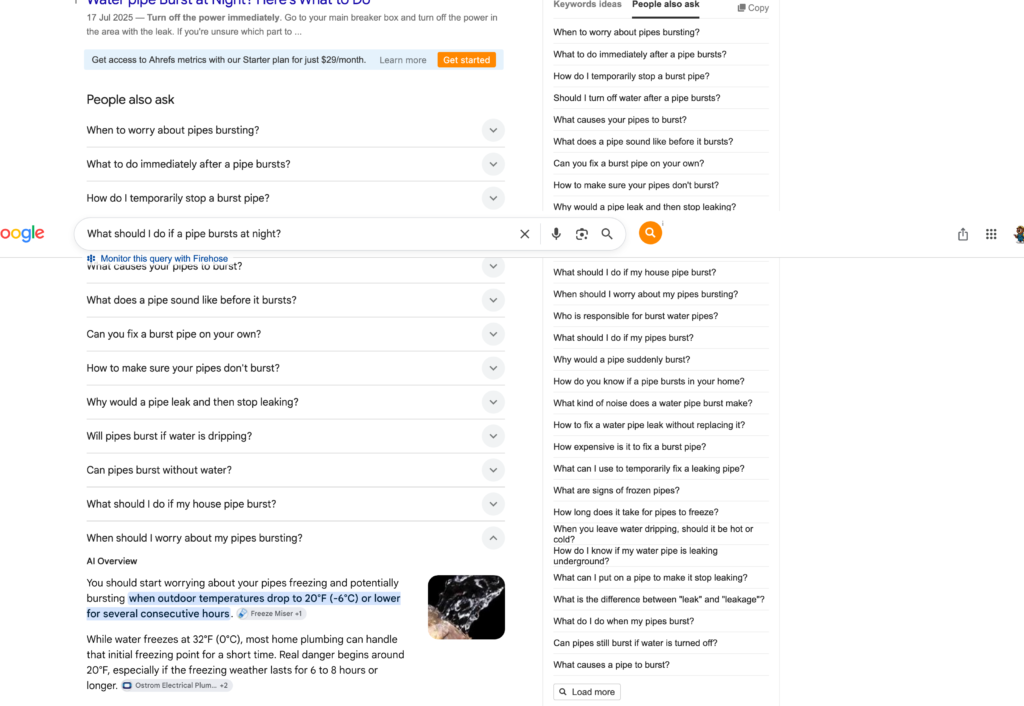
Traditional keyword research often focuses on short phrases such as “plumber near me.” AI users are more likely to describe the entire situation, making question research essential.
Build content around four stages of customer intent:
| Intent | Example AI question | Best content type |
|---|---|---|
| Emergency | “What should I do if a pipe bursts at night?” | Emergency guide with immediate safety steps and call option |
| Diagnostic | “Why does my drain keep backing up after cleaning?” | Expert troubleshooting article |
| Comparison | “Hydro jetting vs. snaking: which is better?” | Side-by-side comparison page |
| Hiring | “Who offers same-day drain cleaning in my area?” | Local service page supported by GBP and reviews |
Start each important section with a direct answer, then supply the explanation, limits and evidence. Use descriptive headings, numbered steps, comparison tables and short paragraphs because they help people find information quickly.
Do not break prose into artificial “AI chunks” or repeat the same keyword in every paragraph. Google’s current guidance says special chunking is unnecessary; clarity should serve the reader first.
Step 5: Strengthen Google Business Profile and Google Maps Signals
For local plumbing searches, your Google Business Profile is a critical source of business information. Keep the business name, categories, service areas, hours, phone, website, appointment links and services accurate.
An effective Google Business Profile optimization strategy should include:
- The most accurate primary and secondary categories.
- Complete services with truthful descriptions.
- Current standard and special hours.
- A working local phone number and website link.
- Authentic job-site, team, equipment and exterior photographs.
- Prompt responses to reviews and customer questions.
- Regular checks for unauthorized edits and duplicates.
- Landing pages that match the profile’s services and location.
Google advises businesses to keep Business Profile information current because local business details may appear in its AI experiences. A complete profile cannot guarantee an AI citation, but inaccurate or incomplete data creates avoidable uncertainty.
Google Local Services Ads are a separate paid channel, not an organic AEO ranking factor. However, an accurate business identity, appropriate verification and effective Google Local Services Ads management can strengthen the overall customer-acquisition system while organic and AI visibility develop.
Step 6: Earn Reviews That Add Useful Evidence
Reviews help prospective customers assess a plumber and may give search systems additional public information about the business. Quality, recency, response behavior and relevance matter more than inserting a target phrase into every review.
Ask customers for honest feedback after completed work. Never dictate exact wording, offer prohibited incentives or purchase reviews.
A natural review may confirm details such as:
- The service performed.
- The city or neighborhood.
- Whether the response was timely.
- How clearly options were explained.
- Whether the work area was protected and cleaned.
- The customer’s experience after the repair.
Respond to positive and negative reviews professionally. A useful response acknowledges the customer, refers naturally to the service when appropriate and avoids publishing private information.
Step 7: Build Trustworthy Citations, Mentions and Links
A citation is an online reference to your business information. A brand mention discusses the company, while a backlink provides a clickable link to its site; one source can contain all three.
Prioritize sources that a real customer or industry participant would trust:
- Major mapping and business platforms.
- State or local licensing resources where applicable.
- Better Business Bureau profiles.
- Local chambers of commerce.
- Plumbing and contractor associations.
- Manufacturer or supplier directories.
- Local newspapers and community publications.
- Sponsorships and charitable partnerships.
- Reputable home-service platforms.
Do not buy bulk placements on irrelevant sites or publish fabricated recommendations. Google specifically warns that seeking inauthentic mentions is not a useful AI-search strategy because its quality and spam systems still apply.
The best links usually come from something worth referencing. Publish original local pricing research, homeowner surveys, plumbing maintenance data, before-and-after findings or a transparent AI visibility study that journalists and industry writers can cite.
Step 8: Add Structured Data Correctly
Structured data helps search engines interpret page information, but it is not a secret AI ranking switch. Google says no special schema is required for AI Overviews or AI Mode.
Useful schema types may include:
Organizationfor the company.- The most accurate
LocalBusinesssubtype for a legitimate local plumbing business. Personfor authors and reviewers.ArticleorBlogPostingfor editorial content.BreadcrumbListfor site hierarchy.Servicewhere the visible page describes that service.VideoObjectfor qualifying original videos.
Every marked-up fact must match the visible page. Validate eligible structured data with Google’s Rich Results Test and monitor Search Console for errors.
FAQ sections remain useful to readers, but FAQ markup is not a reliable rich-result tactic for a plumbing site. Google generally limits FAQ rich results to well-known authoritative government and health websites.
Step 9: Make the Website Accessible to Search Crawlers
The best article cannot be cited if a platform cannot retrieve it. Check your robots.txt, page-level robots directives, firewall, content-delivery network and security plugins for unintended blocks.
Your technical audit should confirm:
- Priority pages return a successful HTTP status.
- Googlebot can crawl the pages.
- OAI-SearchBot is not blocked if you want ChatGPT Search discovery.
- Important pages do not contain
noindex. - Canonical tags point to the intended URLs.
- Important text exists in crawlable HTML.
- XML sitemaps include only canonical, indexable URLs.
- Internal links lead to priority services and locations.
- Mobile pages load quickly and remain usable.
- Calls, forms and conversion tracking work correctly.
Google does not require an llms.txt file for its AI features. Do not let a fashionable but unsupported file distract you from indexing, useful content and site quality.
Step 10: Publish First-Hand Plumbing Evidence
Generic articles define a clogged drain. Expert articles help a homeowner understand what different symptoms may indicate, what a technician tests and why one repair may be recommended over another.
Useful first-hand evidence includes:
- Original job photographs with customer permission.
- Short videos showing diagnostic tools and repair stages.
- A named plumber explaining a common local problem.
- Real case studies with the city, problem, diagnosis and outcome.
- Comparisons based on field conditions, not manufacturer copy.
- Locally relevant water-quality, climate or housing information.
- Clearly sourced statistics and public data.
Add a byline, author biography, publication date and review date. For technical plumbing advice, use a qualified plumber as the writer, contributor or reviewer and state the person’s relevant experience accurately.
Step 11: Optimize for Citations, Not Keyword Repetition
An AI citation is more likely to be useful when a passage supplies a clear fact, explanation or process that directly supports the generated answer. Write self-contained sections that remain accurate when read out of context.
Use this answer pattern:
- Direct answer: Resolve the question in one or two sentences.
- Qualification: Explain when the answer changes.
- Evidence: Provide experience, data or a credible source.
- Action: Tell the homeowner what to do next.
For example, do not write, “Hydro jetting is always the best drain-cleaning method.” Explain which blockages it may address, when pipe condition should be assessed and when another method may be safer.
This style supports readability, trust and passage-level relevance. It is also more persuasive than repeating phrases such as AI SEO for plumber, plumber AI SEO or Chat GPT marketing for plumbers unnaturally.
Step 12: Measure AI Visibility and Business Results
AI visibility is useful only when it contributes to qualified leads and booked work. Measure discovery, engagement and revenue together.
Track:
- Pages appearing in Google’s generative AI reporting where available.
- Search Console impressions, clicks, queries and landing pages.
- Referral traffic from AI platforms in GA4.
- Branded-search growth.
- Calls and forms by landing page and source.
- AI prompt mentions and citations over time.
- Accuracy of generated business information.
- Booked jobs and revenue from traceable AI referrals.
Use UTM-tagged links where you control the source, and ask new callers how they found the company. AI platforms may not pass complete referral data, so combine analytics with call tracking, form tracking and customer-reported attribution.
Review the same prompt set monthly. Compare changes over several months rather than celebrating or reacting to one generated answer.
Common AEO Mistakes Plumbing Companies Should Avoid
Treating AEO as a replacement for SEO
Google’s AI features use its Search infrastructure. A site with weak indexing, thin pages and little authority will not solve those problems by adding an AEO label.
Publishing mass-produced location pages
Swapping city names in identical copy creates little local value. Build pages only when you can add genuine service information, local context, proof and a useful customer journey.
Making claims without evidence
Claims such as “number-one plumber” or “fastest response” require support. Use specific, verifiable facts instead of unqualified superlatives.
Blocking important crawlers
Some security settings block unfamiliar bots automatically. Review logs and crawler rules carefully before assuming ChatGPT can access the site.
Adding unsupported schema
Schema must describe visible, accurate content. Marking up fake reviews, locations or services creates risk and does not manufacture authority.
Ignoring third-party information
Your website is only one source. Outdated hours, duplicate profiles and conflicting phone numbers elsewhere can weaken confidence in the business’s details.
Measuring mentions without measuring calls
A mention for a broad educational query may generate no local jobs. Connect AI visibility work to relevant services, local landing pages, calls, forms and booked revenue.
A 90-Day AI SEO Plan for Plumbers
Days 1–30: Establish the foundation
- Test at least 25 commercial and informational prompts.
- Audit indexing, canonical tags, crawler access and sitemaps.
- Correct business information across the website and key profiles.
- Complete the Google Business Profile.
- Identify missing priority service and location pages.
- Improve the About, Contact and author pages.
- Configure call, form and analytics tracking.
Days 31–60: Build useful answers and proof
- Upgrade the five highest-value service pages.
- Publish two expert comparison or diagnostic guides.
- Add original job photographs and case evidence.
- Implement accurate Organization, Article and breadcrumb schema.
- Request honest reviews from completed jobs.
- Correct inconsistent citations and duplicate listings.
Days 61–90: Build authority and evaluate progress
- Publish a local study, survey or data-led resource.
- Pitch the findings to relevant local and trade publications.
- Secure qualified expert contributions and partnerships.
- Retest the original prompt set.
- Review Search Console, GA4, calls and booked jobs.
- Update pages based on missed questions and inaccurate answers.
Plumbing markets differ in competition, website history and current authority. Ninety days is enough to build the system and detect early changes, but no ethical agency can promise a fixed ranking or AI recommendation by a particular date.
Complete AEO for Plumbers Checklist
Business identity
- Official business name is consistent.
- Phone, address or service-area information is accurate.
- Hours and emergency availability are clear.
- Ownership and credentials are verifiable.
- Service areas and core services are explicitly stated.
Website and content
- Every priority service has a substantial page.
- Location pages contain unique local value.
- Important questions receive direct, qualified answers.
- Content includes original experience or evidence.
- Authors and reviewers are clearly identified.
- Internal links connect related services and guides.
Local authority
- Google Business Profile is complete and current.
- Duplicate profiles and citation conflicts are resolved.
- New, honest reviews arrive consistently.
- Review responses protect customer privacy.
- Relevant associations and local profiles are maintained.
Technical accessibility
- Priority URLs are indexable and canonical.
- Googlebot can crawl the content.
- OAI-SearchBot access matches your search-discovery preference.
- XML sitemaps are clean and current.
- Structured data matches visible content.
- Mobile speed, forms and call buttons work.
Measurement
- A fixed prompt set is tested monthly.
- Mentions, links, sources and inaccuracies are recorded.
- Search Console and GA4 are configured.
- Calls and forms are attributed where possible.
- Visibility is evaluated against booked jobs and revenue.
Frequently Asked Questions About AEO and AI SEO for Plumbers
What is AEO for plumbers?
AEO for plumbers is the practice of making a plumbing company easier for answer engines to understand, verify and cite. It combines traditional SEO, local optimization, clear service information, expert content, reviews, consistent business details, structured data and credible third-party mentions. AEO can improve eligibility for visibility, but it cannot guarantee a recommendation.
How can a plumbing company show up in ChatGPT?
To improve the chance of appearing in ChatGPT Search, publish crawlable and useful content, keep business facts consistent, earn reputable mentions and allow OAI-SearchBot if search discovery is desired. Create detailed service and location pages that answer the questions customers ask. OpenAI does not provide a paid or manual submission that guarantees an organic recommendation.
How does ChatGPT decide which plumber to recommend?
OpenAI does not publish a fixed local-plumber ranking formula. ChatGPT Search may retrieve current web information and cite sources based on the question, available search results and supporting evidence. Clear service relevance, accurate local information, reputable reviews, strong organic visibility and independent corroboration can make a plumbing company easier to evaluate.
How do plumbers appear in Google AI Overviews?
A plumber’s webpage must first be indexed and eligible for a normal Google Search snippet. Google recommends sound technical SEO, helpful people-first content, internal links, accurate structured data and current Business Profile information. There is no special AEO schema or separate submission process for Google AI Overviews.
Is AI SEO for plumbers different from traditional plumber SEO?
AI SEO for plumbers places greater emphasis on conversational questions, clear answer passages, entity consistency and citations in generated responses. Traditional plumber SEO focuses more directly on rankings, organic clicks and local visibility. The two strategies share the same foundation and should be managed together rather than as competing systems.
Does Google Business Profile help plumber AI SEO?
An accurate Google Business Profile helps Google understand a plumbing company’s category, location, hours, services and contact details. Google states that current Business Profile information can support local-business visibility within its search experiences. GBP optimization does not guarantee an AI Overview citation, but incomplete or conflicting information can weaken local discoverability.
Do online reviews help plumbers appear in ChatGPT and Google AI?
Reviews provide public evidence about customer experiences, services and reputation. They may support the broader information available about a plumbing company, but review volume alone does not guarantee an AI recommendation. Plumbers should earn honest reviews consistently, follow each platform’s policies and respond professionally without exposing customer information.
Does schema markup improve AEO for a plumbing company?
Accurate schema markup helps search engines interpret business, author, article, service and breadcrumb information. It can support understanding and eligibility for certain search features, but it does not guarantee rankings or AI citations. The structured data must match visible content and follow Google’s guidelines.
Do plumbers need an llms.txt file to rank in Google AI?
No. Google explicitly says an llms.txt file or special AI text file is not required to appear in AI Overviews or AI Mode. Plumbing companies should prioritize crawlability, indexing, useful content, internal linking, accurate business information and genuine authority. Other platforms may develop different practices, so review current official documentation before implementing new files.
What is ChatGPT marketing for plumbers?
ChatGPT marketing for plumbers refers to improving a plumbing company’s discoverability when people use ChatGPT to research problems, compare options or find providers. It may include technical access, plumber SEO, helpful content, brand consistency, expert evidence and third-party authority. It should not be presented as a guaranteed method for controlling ChatGPT’s answers.
How long does plumber AI SEO take?
The timeline depends on the website’s history, competition, indexing, content, local authority and existing reputation. Technical corrections may be processed after recrawling, while content authority and trusted mentions often require several months. Measure monthly trends in citations, organic visibility, calls and booked work rather than expecting one fixed date.
Can an AEO agency guarantee that ChatGPT will recommend my plumbing company?
No reputable AEO or plumber AI SEO agency can guarantee a particular ChatGPT or Google AI recommendation. Generated answers change by prompt, time, location and available sources, while the platforms control their own systems. An agency can improve accessibility, relevance, authority and measurement, which strengthens the probability of being considered.
Which content helps a plumbing company get cited by AI search engines?
Useful citation candidates include original studies, locally relevant cost factors, diagnostic guides, service comparisons, maintenance instructions and documented case studies. Each page should answer a defined question, explain important limitations and support claims with first-hand expertise or authoritative sources. Generic AI-written summaries provide little reason for another system to cite the company.
How can plumbers track leads from ChatGPT and Google AI?
Use GA4 referral reports, Search Console data, call tracking, landing-page conversion tracking and “How did you hear about us?” questions. Maintain a monthly prompt-tracking sheet for mentions and sources. Because AI platforms may not pass complete referral information, combine digital attribution with call recordings, CRM data and customer responses.
Should a plumbing company optimize for ChatGPT, Gemini and Perplexity separately?
Begin with shared fundamentals: accessible pages, clear business facts, expert content, local relevance and trustworthy mentions. Then test each platform because their sources and answers can differ. Use the findings to correct missing information and expand useful content without creating separate duplicate pages for every AI platform.
How often should an AEO for plumbers guide be updated?
Review a core plumber AEO guide at least quarterly and after major platform or documentation changes. Update crawler guidance, screenshots, original test results and measurement instructions when necessary. Show the publication and review dates so readers understand when the information was verified.
Prepare Your Plumbing Business for AI Search
AI search does not eliminate the need for excellent plumbing service or proven SEO. It raises the standard of online evidence by requiring businesses to be easy to discover, understand and verify across websites, profiles, reviews and independent sources.
Start with accurate fundamentals, answer real homeowner questions and publish proof that competitors cannot copy. Then measure whether stronger visibility produces calls and booked jobs—not just brand mentions.
If you need the best plumber marketing agency in San Diego, CA, and throughout the USA, call FlowLead Digital at (858) 351-0430. We help plumbing companies improve SEO and AI search visibility, strengthen Google Maps performance, build conversion-focused websites and turn online discovery into qualified calls.
Contact FlowLead Digital or review our plumber and HVAC Growth Plans to get started.

Ready to Get More Calls From Google and AI Search?
FlowLead Digital helps plumbing and HVAC companies rank higher, strengthen their Google Maps presence and generate more qualified leads through SEO, web design and AI search optimization.
Book Your Free Strategy Call