Google Maps vs. Your Plumbing Website: Which Wins First?
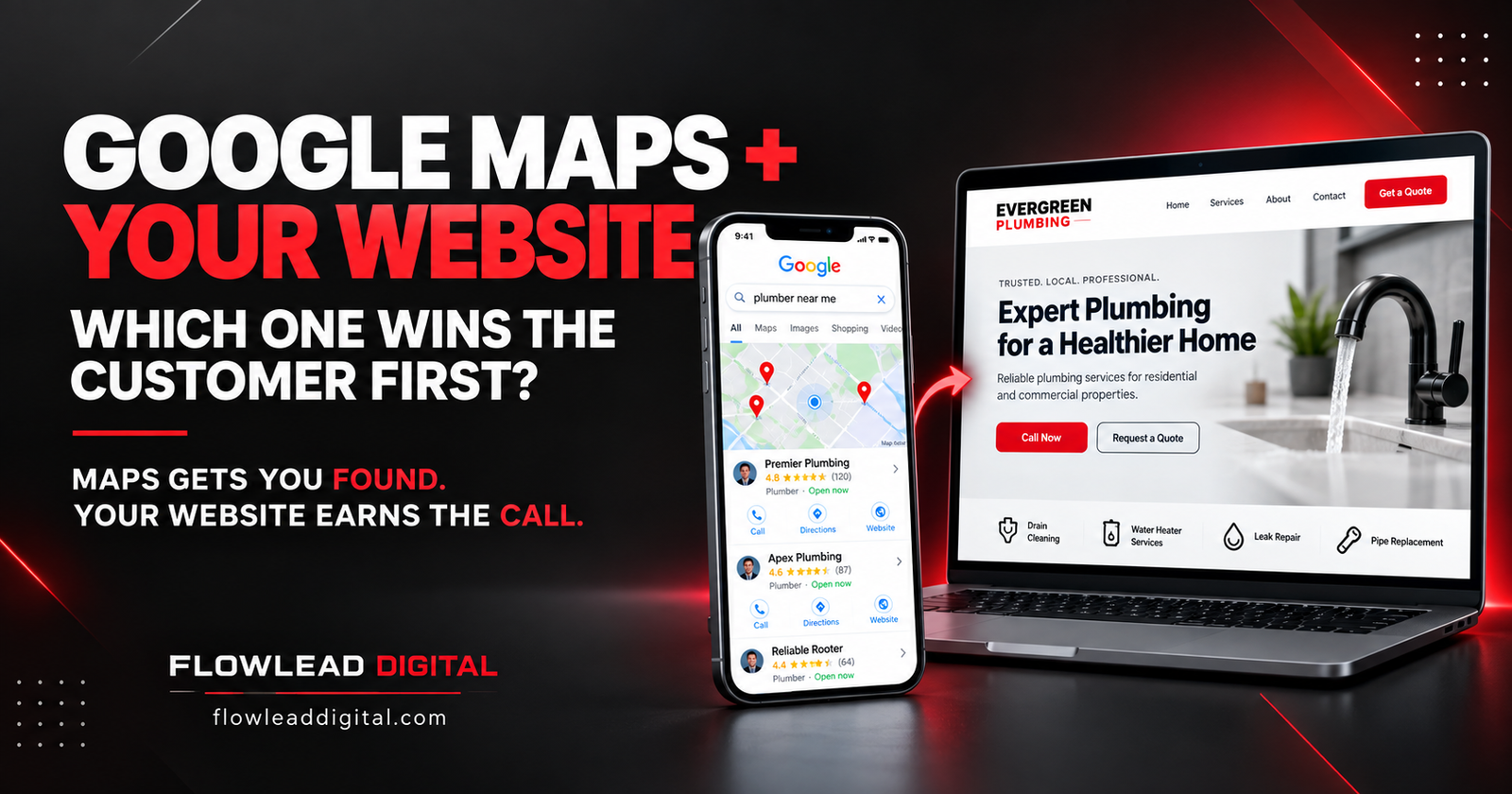
Google Maps vs. Plumbing Websites: Which Gets More Calls?
Where does a homeowner decide which plumbing company to call? The answer is not always your website, and it is not always Google Maps. A customer with a burst pipe may call directly from your Google BusinessWhere does a homeowner decide which plumbing company to call? The answer is not always your website, and it is not always Google Maps. A customer with a burst pipe may call directly from your Google Business Profile, while someone planning a repipe or tankless water heater installation may visit several service pages, read reviews, compare financing, and confirm your credentials first. That difference creates the search-to-call gap: the space between being visible and earning the call.
This guide explains how Google Maps, your plumbing website, local SEO, and AI search work together throughout the customer journey. You will learn which channel usually creates the first impression, what makes homeowners move forward, how to connect your GBP and website, and which improvements can turn more searches into qualified plumbing leads and booked jobs.
Quick answer: Google Maps often wins the first moment of discovery, especially during urgent searches. Your website usually wins the deeper trust decision for higher-value or carefully researched work. The strongest plumber SEO strategy connects both so customers can find, verify, and contact you without friction.
The Search-to-Call Journey
Plumbing customers follow different paths based on urgency and job value. An emergency customer may search “plumber near me,” scan the map results, and call immediately. Someone comparing sewer replacement, repiping, or tankless water heater installation may research several companies first.
A complete journey often looks like this:
Google Search → Google Maps → Google Business Profile → Website → Call or Form → Qualified Lead → Booked Job
Rankings alone do not measure success. Visibility creates the opportunity; relevance, trust, and a clear next step turn it into revenue.
Google Maps vs. a Plumbing Website: What Does Each One Do?
Google Maps and your website perform different jobs. One should not replace the other.
| Channel | Main purpose | What customers check | Likely action |
|---|---|---|---|
| Google Maps and GBP | Local discovery and quick verification | Proximity, hours, reviews, availability, phone number | Call, directions, message, or website visit |
| Plumbing website | Research and trust building | Services, experience, service areas, financing, proof | Call, form, booking, or estimate request |
| Service pages | Match a problem with a solution | Confirmation that you handle the exact job | Service-specific inquiry |
| AI search | Summarize and compare information | Clear facts, authority, reputation, and local relevance | Brand search, citation click, or contact |
Google states that local results are mainly influenced by relevance, distance, and prominence. Complete information supports relevance, while reviews, ratings, and links can contribute to prominence. No plumbing SEO company can buy or guarantee an organic local ranking. See Google’s local ranking guidance.
When Google Maps Wins the Customer First
Google Maps is often the first—and sometimes the only—step during an urgent plumbing problem. A homeowner with a burst pipe, sewer backup, or failed water heater wants fast answers:
- Is the company open?
- Does it serve my location?
- Does it handle this problem?
- Are the reviews recent and credible?
- Can I call immediately?
Your Google Business Profile should answer those questions quickly. Use accurate categories, hours, contact details, service areas, services, and real job photos.
Practical optimization tips include:
- Use accurate categories. “Plumber” will usually be primary, supported only by relevant secondary categories.
- List genuine services. Describe your drain, water heater, sewer, leak, repiping, and emergency services accurately.
- Publish original photos. Show technicians, trucks, equipment, and completed jobs.
- Build reviews ethically. Request honest feedback without incentives, review gating, or fabrication.
- Respond professionally. Acknowledge the customer without forcing keywords into the reply.
FlowLead Digital’s Google Business Profile optimization services connect Maps visibility with measurable calls and booked jobs.
When Your Plumbing Website Wins the Customer First
Your website becomes more important as a job’s price, complexity, or risk increases. Customers comparing repiping, trenchless sewer repair, or a new HVAC system need more information than a map listing provides.
A strong plumber website should clearly explain:
- Services and legitimate service areas.
- Experience, credentials, reviews, and real team information.
- Emergency availability and financing, when applicable.
- What happens after contact and why customers should choose you.
Professional plumber website design is not only about appearance. The site must load quickly on mobile, present a clickable phone number, explain services, build confidence, and guide visitors toward one clear action.
Include a useful homepage, About page, individual service pages, genuine location pages, reviews, and a simple contact page. Add financing information when applicable. Avoid thin pages that merely change the city name.
What Is the Search-to-Call Gap?
The search-to-call gap is the difference between appearing in front of a potential customer and persuading that person to contact your company.
You can rank in Maps and lose the call because reviews are outdated. You can earn a website visit and lose the lead because the site is slow, hides the phone number, or does not explain the requested service.
Common gaps include an outdated GBP link, inconsistent information, weak mobile design, long forms, missing credentials, generic service content, and poor conversion tracking. Effective SEO services for plumbers should improve the complete journey—not merely report rankings.
How to Connect Your GBP and Plumbing Website
Your GBP and website should provide consistent answers about who you are, what you do, where you work, and how customers can contact you.
1. Use the correct website URL
A single-location company will normally link GBP to its canonical homepage. Each eligible profile for a legitimate multi-location business may use its corresponding location page. Never create fake locations or doorway pages.
Use UTM tracking when supported to separate GBP visits from other organic traffic.
2. Keep business details consistent
Align your official name, phone number, hours, address or service-area status, and services across the website, GBP, and trusted citations.
3. Match GBP services with website pages
If GBP lists hydro jetting, the website should explain when it is appropriate, how it works, its limitations, and how to request service. Apply this principle to every core service.
4. Strengthen conversions and tracking
Use a clickable mobile number, clear buttons, short forms, and realistic next steps. Track GBP and website calls, visits, forms, qualified leads, booked jobs, and lead value.
How Plumber SEO and AI Search Work Together
Plumber SEO improves visibility across organic search, local results, and customer discovery. A complete strategy may include:
- Technical crawling and indexing checks.
- Mobile speed and usability improvements.
- Keyword and customer-intent research.
- Service and location content.
- Titles, headings, internal links, and descriptive image alt text.
- Google Business Profile optimization.
- Review, citation, and local authority development.
- Call, form, lead-quality, and booked-job tracking.
AI SEO for plumbers—also called AEO or answer engine optimization—helps AI platforms find, understand, verify, and cite accurate business information. It does not replace traditional SEO, GBP optimization, or a strong website. It builds on them.
For AI-search readiness, publish crawlable pages, state services and locations clearly, answer questions directly, identify the author, use original photos, maintain consistent facts, and earn genuine reviews and credible mentions. Structured data must match visible content.
Google recommends people-first content that demonstrates experience, expertise, clear authorship, and trust. E-E-A-T is a quality framework, not a single ranking factor. Review Google’s people-first content guidance and FlowLead Digital’s guide to AI SEO for plumbers.
Cheap SEO vs. Affordable SEO for Plumbers
“Cheap SEO for a plumber” and “affordable SEO for plumbers” are different. Cheap SEO may rely on duplicated content, fabricated locations, low-quality links, fake reviews, or automated reports that produce little value.
Affordable SEO is properly scoped. It may begin with an audit, GBP optimization, core-page improvements, mobile conversion fixes, ethical review generation, and call tracking.
Before hiring a company that offers SEO for plumbers, ask what work is included, who owns the website and accounts, how leads are measured, whether content is original, and how links are earned. Avoid any plumbing SEO company that guarantees rankings or promises calls without evaluating your market, competition, capacity, and current online presence.
Choosing a Marketing Agency for Plumbers
A marketing agency for plumbers should understand emergency intent, service areas, job value, call handling, and local competition. Ask whether it tracks booked jobs, connects GBP with website performance, protects account ownership, and reports transparently.
If you are comparing a national provider with a San Diego marketing agency, do not choose based only on geography. Choose relevant plumbing experience, honest communication, clear ownership terms, and a strategy matched to your market. Explore FlowLead Digital’s complete plumbing marketing services.
About Phillip Jordan
Phillip Jordan, founder of FlowLead Digital, has worked in digital marketing for plumbing and HVAC companies since 2010. Before starting FlowLead Digital, he spent 12 years working with leading home-service marketing agencies in the United States, helping create content and growth strategies for plumbing businesses.
He founded FlowLead Digital after seeing contractors pay for unclear packages, weak content, and marketing focused on activity instead of value. His mission is to help change the plumber marketing industry through transparent strategy, practical education, accountable service, and work tied to qualified calls, booked jobs, and sustainable growth.
Search-to-Call Checklist
- Verify that GBP ownership, categories, hours, services, phone number, and service areas are accurate.
- Match important GBP services with substantial website pages.
- Keep the website secure, crawlable, fast, and mobile-friendly.
- Make the phone number and main call to action immediately visible.
- Publish genuine service-area content, recent reviews, and real team or job photos.
- Track calls, forms, qualified leads, booked jobs, and revenue by source.
- Review performance regularly and connect reporting to business outcomes.
Frequently Asked Questions
1. Is Google Maps or a plumbing website more important for getting calls?
Google Maps often creates the first impression and generates direct calls. A plumbing website provides deeper proof for customers comparing services, credentials, reviews, financing, and high-value projects. Strong plumber SEO connects both channels.
2. How should a plumber connect a website to Google Business Profile?
Add the correct canonical URL, maintain consistent business details, align GBP services with relevant website pages, and use legitimate service areas. Add UTM tracking when appropriate, then measure calls, forms, qualified leads, and booked jobs.
3. Can a plumbing company rank on Google Maps without a website?
A verified business can appear in local results without a website, but it loses valuable trust, organic visibility, and conversion support. A strong website clarifies the company’s services, locations, experience, and credibility.
4. What should a plumber website include to generate calls?
Include a clear value proposition, clickable phone number, short form, service pages, genuine location information, reviews, credentials, real photos, emergency details, financing when applicable, FAQs, and strong calls to action. The site should be secure, fast, mobile-friendly, crawlable, and tracked.
5. What is AI SEO for plumbers, and does it replace traditional SEO?
AI SEO for plumbers helps answer engines verify a company’s services, locations, experience, and reputation through clear answers, structured content, consistent facts, credible mentions, and reviews. It builds upon plumbing company SEO, GBP optimization, and strong service pages.
6. How can I find affordable SEO services for plumbers?
Choose a plumbing SEO company that defines its work, sets realistic expectations, creates original content, protects account ownership, and tracks qualified calls and booked jobs. Affordable SEO prioritizes high-impact work. Extremely cheap SEO may create costly spam, duplication, or compliance problems.
Turn More Plumbing Searches Into Booked Jobs
If you need a plumbing marketing company that will go above and beyond, call FlowLead Digital at 858-351-0430. Our team connects plumber SEO, Google Business Profile optimization, website design, and AI search strategy into one measurable growth system. Let us identify your search-to-call gaps and build a plan focused on qualified leads, booked jobs, and lasting value.

Ready to Get More Calls From Google and AI Search?
FlowLead Digital helps plumbing and HVAC companies rank higher, strengthen their Google Maps presence and generate more qualified leads through SEO, web design and AI search optimization.
Book Your Free Strategy Call