AI Overview Summary
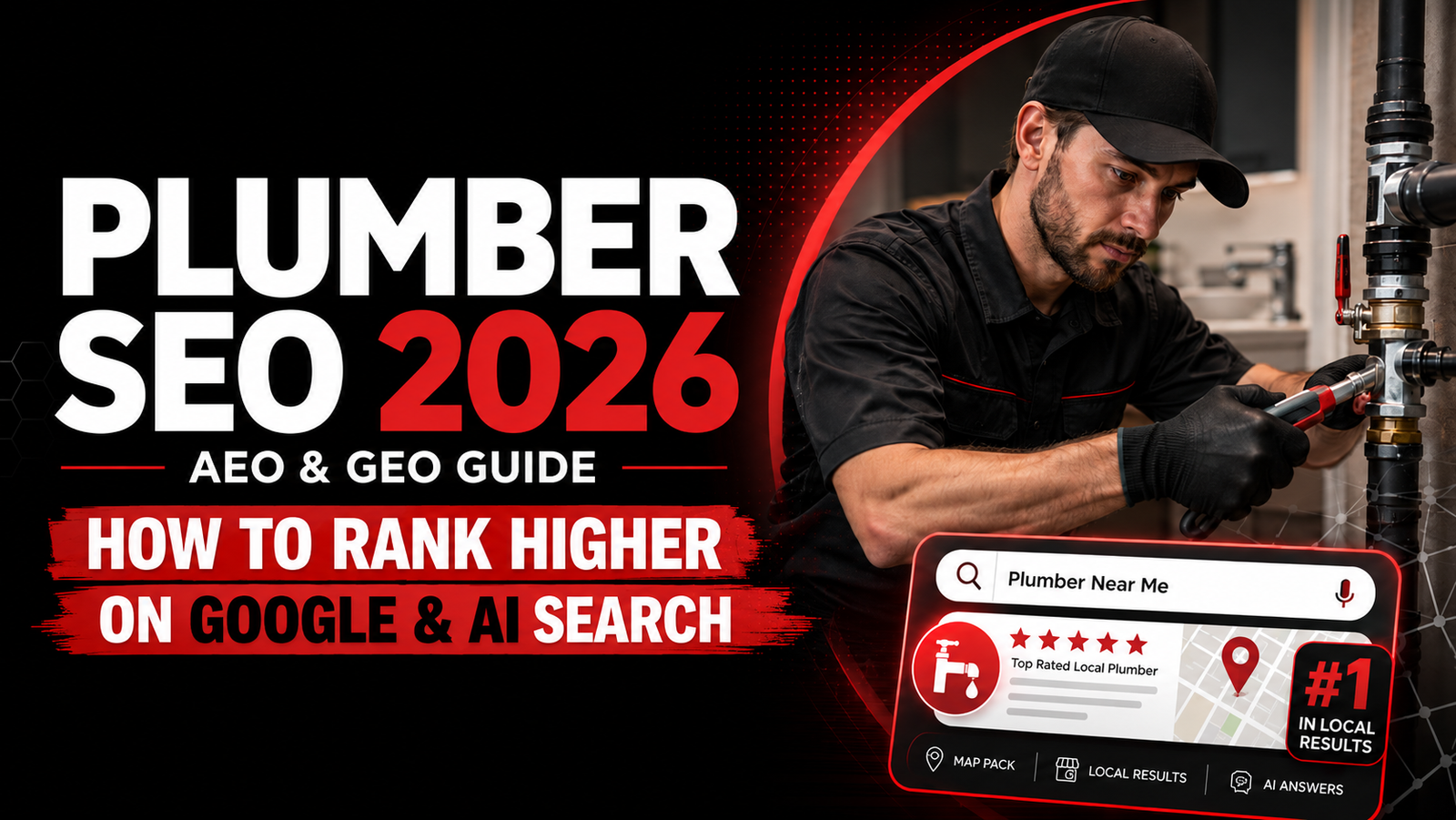
Plumber SEO is the process of improving a plumbing company’s website, Google Business Profile, service pages, local authority, reviews, and online visibility so the business can rank higher in Google Search, Google Maps, and AI-powered search results. In 2026, plumbing companies also need AEO, or Answer Engine Optimization, to answer customer questions clearly, and GEO, or Generative Engine Optimization, to help AI tools understand, trust, and recommend their business. A strong plumber SEO strategy should include local SEO, technical SEO, content marketing, Google Business Profile optimization, review growth, service area pages, internal linking, structured data, and conversion-focused website design.
Plumbing companies are facing a new kind of search market in 2026.
A few years ago, most homeowners searched short phrases like “plumber near me,” “emergency plumber,” or “water heater repair near me.” Today, search is more conversational. Customers ask longer questions. They compare companies faster. They check reviews before calling. They use Google Maps, Google Search, AI Overviews, ChatGPT, Gemini, Perplexity, Claude, and Copilot to get answers before they choose a contractor.
That shift matters.
Google is still one of the strongest lead sources for plumbing companies. Google Maps still drives high-intent phone calls. A plumbing website still needs to rank for service and city keywords. But AI-powered search is changing how customers find, compare, and trust local businesses.
That means plumbing companies can no longer rely on old SEO tactics.
A five-page website is not enough. A weak Google Business Profile is not enough. Random blog posts are not enough. Keyword stuffing does not work. Thin city pages do not build trust. A slow website can cost real calls. A profile with few reviews can lose business to competitors before the customer ever visits your site.
In 2026, plumbing companies need three search systems working together:
- Plumber SEO to rank on Google Search and Google Maps.
- AEO to answer direct questions in search results, voice search, and AI answers.
- GEO to help generative AI tools understand, trust, and recommend the business.
This guide explains how plumber SEO, AEO, and GEO work together. It is written for plumbing business owners who want more calls, better leads, stronger Google Maps visibility, and long-term growth.
It is also written for contractors who are tired of guessing.
If your plumbing company is not showing up on Google, if your competitors outrank you in the map pack, or if your website gets traffic but no calls, this guide will show you what needs to change.
For plumbing and HVAC companies that want help turning search visibility into booked jobs, FlowLead Digital offers full-service plumber SEO and HVAC SEO services, Google Business Profile optimization, and conversion-focused web design built for contractors.
What Is Plumber SEO?
Plumber SEO is the process of improving a plumbing company’s online presence so the business can rank higher when local customers search for plumbing services.
In simple terms, SEO for plumbers helps your company get found by people who already need what you offer.
A homeowner with a clogged drain does not want to read a random article. They want help. A property manager with a leaking water heater wants a trusted plumber who can respond quickly. A business owner dealing with a sewer backup wants clear answers and a company that looks reliable.
That is where plumbing SEO comes in.
Strong plumber SEO helps your company show up for searches like:
- plumber near me
- emergency plumber near me
- drain cleaning in [city]
- sewer line repair in [city]
- water heater repair in [city]
- leak detection in [city]
- commercial plumber in [city]
- best plumbing company in [city]
- plumber open now
- water heater replacement near me
- hydro jetting near me
Good SEO does not only bring traffic. It brings the right traffic.
The goal is not to attract random visitors. The goal is to bring homeowners and businesses who are ready to call, book, or request service.
A complete plumbing SEO strategy includes several moving parts.
On-Page SEO
On-page SEO is the work done on your website pages.
This includes your page titles, meta descriptions, headings, keyword placement, image alt text, internal links, calls to action, service descriptions, FAQs, and page structure.
For example, your drain cleaning page should not only say, “We offer drain cleaning.” It should explain:
- Common signs of a clogged drain
- What causes drain blockages
- When to call a plumber
- How your drain cleaning process works
- What tools may be used
- Which areas you serve
- Why customers should trust your company
- How to request service
A weak service page gives Google very little to work with.
A strong page answers real customer questions and gives search engines a clear reason to rank it.
Local SEO
Local SEO for plumbers helps your business rank in your actual service area.
This includes your Google Business Profile, reviews, local citations, city pages, service area pages, local backlinks, and location-based content.
For plumbers, local SEO is often more important than broad national SEO.
You do not need to rank everywhere. You need to rank where your customers are.
If you serve Dallas, Houston, Tampa, San Diego, Phoenix, Atlanta, Charlotte, Denver, or any local market, your website and Google Business Profile must make your service area clear.
Google and AI search tools need to understand four things:
- Who you are
- What services you provide
- Where you provide them
- Why customers should trust you
That is the foundation of local SEO for plumbers.
For companies that need help improving local visibility, FlowLead Digital provides Google Business Profile optimization and full SEO services for plumbing contractors.
Technical SEO
Technical SEO is the foundation of your website.
It includes site speed, mobile performance, crawlability, indexing, broken links, redirects, schema markup, HTTPS security, image compression, and clean site structure.
A plumbing website can look nice and still fail if the technical setup is poor.
Common technical SEO problems include:
- Slow loading pages
- Broken links
- Duplicate pages
- Missing title tags
- Poor mobile layout
- Large images
- Weak hosting
- No sitemap
- Pages blocked from indexing
- Poor Core Web Vitals
- Bad URL structure
Most plumbing customers search from a phone. If your website is slow, hard to use, or difficult to call from, you lose leads.
A fast, mobile-friendly website is no longer optional.
FlowLead Digital builds plumbing websites designed to rank, load fast, and convert visitors into booked jobs.
Content SEO
Content SEO is the process of publishing helpful website content that answers real customer questions.
For plumbing companies, content includes:
- Service pages
- City pages
- Blog posts
- FAQs
- Case studies
- Cost guides
- Maintenance guides
- Emergency plumbing guides
- Comparison pages
- Troubleshooting articles
Examples include:
- Why does my drain keep clogging?
- How long does a water heater last?
- What causes low water pressure?
- How do I know if my sewer line is damaged?
- Should I repair or replace my water heater?
- What is hydro jetting?
- How much does sewer line repair cost?
- Why is my plumbing company not ranking on Google?
Helpful content builds authority. It also gives Google and AI search engines more information to understand your business.
Link Building
Link building is the process of earning links from other websites.
For local plumbing companies, strong links often come from:
- Local chambers of commerce
- Local directories
- Sponsorships
- Community events
- Local news sites
- Vendor partners
- Trade associations
- Supplier websites
- Neighborhood organizations
- Business partnerships
Backlinks help search engines understand that your business is known, trusted, and connected.
For plumbers, quality matters more than quantity.
One strong local link from a trusted community website can be more valuable than dozens of low-quality links from spam directories.
Why Plumber SEO Matters More in 2026
Plumber SEO matters because customers are searching before they call.
When a homeowner has a plumbing problem, they often go to Google first. They check Google Maps. They compare reviews. They look at photos. They scan the website. They decide quickly who looks trustworthy.
If your company does not appear where customers are searching, your competitors get the call.
SEO also matters because paid ads are getting more expensive. Google Ads and Local Services Ads can work well, but they require ongoing budget. When your budget stops, the lead flow stops.
SEO builds long-term visibility.
A strong plumber SEO system can help your business:
- Rank higher in Google Search
- Appear more often in Google Maps
- Get more calls from local customers
- Build trust before the customer calls
- Reduce dependence on paid ads
- Support Google Local Services Ads
- Improve conversion rates
- Build long-term authority
- Show up in AI-powered search results
SEO is not just about rankings.
It is about being visible when the right customer is ready to act.
Search Intent Is the Real Opportunity
Every plumbing search has intent.
Some searches show urgent buying intent.
Examples:
- emergency plumber near me
- burst pipe repair near me
- sewer backup plumber
- water heater leaking now
- plumber open today
Other searches show research intent.
Examples:
- why is my water heater leaking
- why does my toilet keep running
- how often should drains be cleaned
- tankless vs traditional water heater
- signs of a sewer line problem
A strong SEO strategy targets both.
Emergency and service keywords bring customers who may call now. Educational keywords build trust and attract customers earlier in the decision process.
That is why plumber SEO should include both service pages and helpful blog content.
What Is AEO for Plumbers?
AEO stands for Answer Engine Optimization.
AEO is the process of creating and formatting content so search engines, voice assistants, and AI tools can quickly understand and use your answers.
Traditional SEO focuses on ranking pages.
AEO focuses on answering questions clearly.
This matters because customers no longer search only with short keywords. They ask full questions.
Examples include:
- What is plumber SEO?
- How do plumbers rank on Google?
- Why is my plumbing company not ranking?
- How can a plumbing company get more leads?
- How does local SEO work for plumbers?
- What causes low water pressure?
- Why is my water heater leaking?
- How do I know if I need sewer line repair?
- How much does drain cleaning cost?
- Who is the best emergency plumber near me?
If your content answers these questions clearly, you improve your chances of appearing in featured snippets, AI Overviews, voice search results, and AI-generated answers.
AEO Starts With Direct Answers
AEO content should be simple, clear, and useful.
A strong answer usually begins with a direct response.
For example, for the question “What causes low water pressure?” a weak answer might say:
“Low water pressure can be frustrating, and there are many things that may affect your home’s plumbing system.”
A better answer would say:
“Low water pressure is usually caused by clogged pipes, a failing pressure regulator, hidden leaks, corroded plumbing lines, partially closed valves, or problems with the municipal water supply.”
The second answer is better because it gives the user immediate value.
After the direct answer, you can add more detail.
AEO Uses Question-Based Headings
Question-based headings help users, Google, and AI tools understand your page.
Use headings like:
- What Is Plumber SEO?
- How Does Local SEO Work for Plumbers?
- Why Is My Plumbing Company Not Ranking?
- How Can Plumbers Get More Calls From Google?
- Can AI Search Recommend My Plumbing Company?
- What Is the Difference Between SEO, AEO, and GEO?
These headings match how people search.
They also make the content easier to scan.
AEO Supports Voice Search
Voice search is important for local service businesses.
A customer may ask:
“Hey Google, find an emergency plumber near me.”
Or:
“Siri, why is my water heater leaking?”
Voice search favors clear, local, direct answers.
That means your content should use plain language. Avoid long, complicated sentences. Avoid keyword stuffing. Make the answer easy to understand.
The goal is to sound helpful, not robotic.
What Is GEO for Plumbers?
GEO stands for Generative Engine Optimization.
GEO is the process of improving your online presence so generative AI tools can understand, trust, and mention your business in AI-powered answers.
These tools include:
- ChatGPT
- Gemini
- Claude
- Perplexity
- Copilot
- Google AI Overviews
- Google AI Mode
GEO is newer than traditional SEO, but the idea is simple.
AI tools need trusted information.
They look for clear content, strong brand signals, consistent business details, reviews, citations, expertise, structured pages, and authority across the web.
If your plumbing business has a weak website, few reviews, inconsistent listings, no helpful content, and no clear brand presence, AI tools have less reason to trust or recommend your business.
If your business has strong local signals, detailed service pages, helpful blogs, real reviews, consistent listings, and trusted mentions, it becomes easier for AI search tools to understand.
That is the heart of GEO for plumbers.
GEO Is Not Magic
Some agencies make GEO sound mysterious. It is not.
For local plumbing companies, GEO usually depends on many of the same signals that already support SEO.
These include:
- A complete website
- Helpful service pages
- Strong Google Business Profile
- Real customer reviews
- Consistent citations
- Local backlinks
- Brand mentions
- Clear author information
- Structured data
- Helpful FAQs
- Case studies
- Strong About page
- Clear contact information
- Service area clarity
AI tools are not looking for keyword-stuffed pages. They are looking for reliable information that helps answer the user’s question.
GEO Requires Strong Entity Signals
An entity is a real thing that search engines and AI systems can understand.
Your plumbing company is an entity.
Your owner is an entity. Your city is an entity. Your services are entities. Your website, Google Business Profile, reviews, social profiles, citations, and local mentions all help define your business online.
The clearer your entity signals are, the easier it is for search engines and AI tools to understand who you are, what you do, where you work, and why customers trust you.
Strong entity signals for plumbers include:
- Same business name across the web
- Same phone number across listings
- Same website URL
- Clear service categories
- Clear service areas
- Real founder or owner information
- Customer reviews
- Local awards
- Memberships
- Supplier or partner links
- Local citations
- Helpful content written or reviewed by knowledgeable people
- A detailed About page
For FlowLead Digital, our About Us page helps support trust by showing who we are, who we serve, our values, and why we focus only on plumbing and HVAC marketing.
SEO vs AEO vs GEO: What Is the Difference?
SEO, AEO, and GEO work together, but they are not the same.
| Search Strategy | Main Goal | Best For | Example |
|---|---|---|---|
| SEO | Rank pages in Google and search engines | Service pages, city pages, blogs, Google Maps | “plumber SEO” or “emergency plumber in Dallas” |
| AEO | Answer direct questions clearly | FAQs, snippets, voice search, AI Overviews | “What is plumber SEO?” |
| GEO | Help AI tools understand and recommend your brand | Brand authority, citations, reviews, structured content | “Who is the best plumber marketing agency for SEO?” |
A plumbing company needs all three.
SEO gets your company found.
AEO helps your content answer questions.
GEO helps AI tools understand and trust your business.
Together, they create a stronger search presence across Google Search, Google Maps, and AI-powered search platforms.
How Google and AI Search Are Changing Plumbing Marketing
AI search is changing how customers make decisions.
In the past, a customer might search “best plumber in Dallas,” click three websites, read reviews, and call one company.
Now, the same customer may ask:
“Who is the best emergency plumber near me with strong reviews and fast response?”
An AI tool may summarize options, compare companies, pull review signals, and give the customer a short list.
That changes the game.
You are no longer competing only for blue links. You are competing for trust inside the answer.
Customers Want Faster Answers
People do not want to search forever.
If a pipe bursts, a drain backs up, or a water heater leaks, they want fast help.
AI search gives people direct answers faster.
That means your website content must be clear enough to be understood and used in those answers.
If your website buries important details, uses vague service pages, or does not answer customer questions, your company may be ignored.
Clicks May Become Harder to Earn
AI search can answer some questions without the user clicking a website.
That does not mean your website no longer matters.
It means your brand needs to be present where answers are formed.
A customer may see your company mentioned in an AI answer, then search your brand name, check your reviews, visit your website, or call directly from your Google Business Profile.
This is why brand visibility matters.
The goal is not just more website traffic.
The goal is to become the trusted answer.
Local Recommendations Are More Competitive
AI-powered search tools are getting better at local recommendations.
They can consider reviews, business details, content, location, service categories, and public mentions.
This is why local SEO for plumbers matters.
A weak Google Business Profile hurts you. Few reviews hurt you. Inconsistent citations hurt you. Thin website content hurts you. A slow website hurts you.
AI search makes weak signals easier to expose.
The 12 Biggest Plumber SEO Ranking Factors in 2026
Plumber SEO is not one thing. It is a system.
Here are the biggest ranking factors plumbing companies should focus on in 2026.
1. Google Business Profile Optimization
Your Google Business Profile is one of the most important assets for plumbing lead generation.
It helps your company appear in Google Maps and the local map pack.
A strong plumber Google Business Profile should include:
- Correct business name
- Main phone number
- Website link
- Primary category
- Secondary categories
- Service areas
- Business hours
- Emergency service details
- Services
- Photos
- Review responses
- Business description
- Questions and answers
- Posts and updates
- Booking or contact options
For most plumbing companies, the primary category should be “Plumber.”
Secondary categories may include relevant services if they apply.
Your profile should also match your website.
If your website says you offer sewer line repair, your Google Business Profile should support that. If your profile lists water heater repair, your website should have a strong water heater repair page.
FlowLead Digital offers Google Business Profile optimization to help plumbing and HVAC companies improve Google Maps visibility and turn more searches into calls.
2. Reviews and Reputation
Reviews are one of the strongest trust signals for plumbing companies.
Customers read reviews before calling. Google uses review signals to understand local prominence. AI tools may also use review quality, review volume, and review sentiment when forming recommendations.
A good review strategy should be steady and natural.
Do not ask for 50 reviews in one day and then stop for six months.
Build a simple system where happy customers are asked to leave a review after completed jobs.
The best reviews mention specific services and locations.
Example:
“ABC Plumbing fixed our water heater in Plano and explained everything clearly.”
That review is more useful than:
“Great job.”
Specific reviews help customers and search engines understand what your company does well.
3. Local Citations
Local citations are mentions of your business name, address, phone number, and website across the internet.
These may appear on directories, map platforms, local business websites, and industry listings.
Citation consistency matters.
If your business name, phone number, or address is different across the web, it can create confusion.
Important citation sources for plumbing companies may include:
- Google Business Profile
- Bing Places
- Apple Business Connect
- Yelp
- BBB
- Angi
- Nextdoor
- Chamber of commerce
- Local contractor directories
- Plumbing association listings
- Supplier directories
Citations support your local SEO and help build confidence in your business information.
4. Service Pages
Service pages are the money pages on a plumbing website.
Each major plumbing service should have its own dedicated page.
A plumbing company should not put every service on one short page.
You should have pages for:
- Emergency plumbing
- Drain cleaning
- Sewer line repair
- Sewer line replacement
- Water heater repair
- Water heater installation
- Tankless water heaters
- Leak detection
- Repiping
- Gas line repair
- Commercial plumbing
- Toilet repair
- Faucet repair
- Fixture installation
Each page should explain the service clearly, answer customer questions, include local context, and make it easy to call.
A strong service page can rank for high-intent keywords and turn visitors into booked jobs.
5. City and Service Area Pages
Service area pages help plumbing companies rank in nearby cities, suburbs, and neighborhoods.
A good city page should not be copied and pasted with only the city name changed.
That is a common SEO mistake.
Each city page should include useful local information, real service details, customer problems, nearby neighborhoods, and clear reasons customers in that area should call your company.
For example, a strong page for “Drain Cleaning in Frisco, TX” should explain:
- Common drain problems in Frisco homes
- Drain cleaning services offered
- Emergency drain cleaning availability
- Nearby areas served
- Why customers in Frisco choose your company
- How to book service
Weak city pages do not rank well because they add little value.
Strong local pages help build relevance.
6. Website Speed and Mobile Experience
Most plumbing searches happen on mobile devices.
A customer with an urgent leak does not want to wait for a slow website. They want to tap, call, and get help.
Your website should load fast, look clean on mobile, and make your phone number easy to click.
Important mobile features include:
- Sticky call button
- Clear headline
- Fast load time
- Easy contact form
- Short paragraphs
- Large readable text
- Simple menu
- Review highlights
- Trust badges
- Service area clarity
Website speed is not just a technical issue.
It affects lead generation.
A slow website can cost calls.
FlowLead Digital builds websites for plumbers and HVAC companies that are designed to be fast, modern, mobile-friendly, and built around booked jobs.
7. Helpful Content
Helpful content is one of the biggest opportunities in plumbing SEO.
Many plumbing websites have thin content. They list services but do not explain enough.
That creates an opening.
If your website gives better answers than your competitors, you can build authority faster.
Helpful content may include:
- Service guides
- Troubleshooting articles
- Cost guides
- Maintenance tips
- FAQs
- Seasonal plumbing advice
- Comparison guides
- Repair vs replacement guides
- Emergency plumbing checklists
For example, a blog titled “Why Does My Drain Keep Clogging?” can attract homeowners searching for answers.
If the article is helpful, the customer may call your company when they realize the problem needs professional service.
8. E-E-A-T Signals
E-E-A-T stands for Experience, Expertise, Authoritativeness, and Trustworthiness.
For plumbing SEO, this means your website should prove that your company is real, experienced, and trustworthy.
Strong E-E-A-T signals include:
- Years in business
- License information where required
- Insurance details where appropriate
- Real company photos
- Real technician photos
- Founder or owner story
- Service process
- Reviews
- Case studies
- Before-and-after photos
- Warranty information
- Financing options
- Emergency service details
- Author bios
- Contact information
- Local service area details
E-E-A-T is not about saying, “We are the best.”
It is about proving why customers can trust you.
9. Internal Linking
Internal linking helps users and search engines move through your website.
It also helps Google understand which pages matter most.
Your blog posts should link to related service pages.
Examples:
- A blog about water heater leaks should link to your water heater repair page.
- A blog about clogged drains should link to your drain cleaning page.
- A blog about sewer odors should link to your sewer repair page.
- A blog about plumber SEO should link to your SEO service page.
For FlowLead Digital, this blog should link naturally to:
- Search Engine Optimization
- Google Business Profile Optimization
- Web Design
- Google Local Services Ads Management
- Growth Plan
- Our Services
- About Us
- Blog
- Contact Us
Internal links should feel natural. Do not force them into every sentence.
A strong internal linking strategy turns your website into a connected authority hub.
10. Local Backlinks
Local backlinks help build authority in your service area.
These links show that your business is connected to the local community.
Good local backlink sources include:
- Local sponsorships
- Chamber of commerce profiles
- Local news mentions
- Charity event pages
- School sponsorship pages
- Vendor partner links
- Local business associations
- Home service directories
- Podcast interviews
- Community blogs
For plumbing companies, local backlinks can be more valuable than random national links.
You want Google to see that your company is trusted in your city.
11. Schema Markup
Schema markup is structured data added to your website code.
It helps search engines understand the content on your page.
For plumbing companies, useful schema may include:
- LocalBusiness schema
- Plumber schema
- Organization schema
- Service schema
- FAQPage schema
- Review schema where appropriate
- Breadcrumb schema
- Article schema for blogs
Schema does not replace helpful content.
It supports it.
Your schema should match what is visible on the page. Do not mark up fake reviews, fake locations, or services you do not offer.
For FlowLead Digital, this blog should use Article schema, FAQPage schema, Breadcrumb schema, and Organization schema.
12. Conversion Tracking
SEO without tracking is guesswork.
A plumbing company should know which marketing efforts are producing calls, forms, and booked jobs.
Important tracking includes:
- Phone calls
- Form submissions
- Google Business Profile actions
- Organic traffic
- Keyword movement
- Map rankings
- Landing page conversions
- Call quality
- Booked jobs when available
- Revenue from leads when possible
Rankings matter, but calls and booked jobs matter more.
At FlowLead Digital, our Growth Plans are built around the bigger picture: visibility, calls, better leads, and long-term growth.
How to Build a Plumbing Website That Ranks
A plumbing website should do two jobs.
It should rank.
It should convert.
Ranking without conversions is wasted traffic. Conversions without visibility mean too few people see your offer.
A high-performing plumbing website needs both.
Clear Site Structure
Your website should be easy to understand.
A simple structure may look like this:
- Home
- About
- Services
- Emergency Plumbing
- Drain Cleaning
- Water Heater Repair
- Sewer Line Repair
- Leak Detection
- Commercial Plumbing
- Service Areas
- City 1
- City 2
- City 3
- Blog
- Reviews
- Contact
This structure helps users and search engines understand your business.
Strong Homepage
Your homepage should explain who you help, what you do, where you serve, and why customers should call.
A plumbing homepage should include:
- Clear headline
- Main services
- Service area
- Phone number
- Reviews
- Trust badges
- Company story
- Process
- FAQs
- CTA
Your homepage should not try to rank for every service.
It should guide users to the right pages.
Dedicated Service Pages
Each major service needs its own page.
This gives Google clear content to rank.
It also gives customers the information they need before calling.
Local Pages
If you serve multiple cities, build strong city pages.
Each page should be unique, useful, and tied to real services.
Blog and Resource Center
Your blog should support your service pages.
Do not publish random content.
Publish articles that answer customer questions and connect to services.
Examples:
- Why Is My Water Heater Leaking?
- How to Know If Your Sewer Line Is Broken
- What Causes Repeated Drain Clogs?
- Should I Repair or Replace My Water Heater?
- How Much Does Emergency Plumbing Cost?
For FlowLead Digital, our Blog should become a resource center for plumbing and HVAC growth, SEO, Google Maps, LSAs, web design, AI search, and lead generation.
How to Optimize Your Google Business Profile
Your Google Business Profile is often the first impression customers see.
For plumbing companies, it can decide whether a customer calls you or a competitor.
Choose the Right Primary Category
Your primary category should match your main service.
For most plumbing companies, this should be “Plumber.”
Choosing the wrong category can hurt visibility.
Add Strong Secondary Categories
Use secondary categories when they accurately describe your business.
Do not add unrelated categories.
Complete Every Section
Fill out your profile fully.
Add:
- Services
- Service areas
- Business hours
- Phone number
- Website
- Photos
- Description
- Questions and answers
- Appointment links when possible
Add Real Photos
Photos build trust.
Add images of:
- Service trucks
- Technicians
- Completed jobs
- Equipment
- Water heaters
- Drain cleaning work
- Sewer projects
- Office or team
- Before-and-after results
Avoid relying only on stock photos.
Build a Review System
Ask happy customers for reviews.
Make it part of your process.
A simple review request sent after a completed job can help build momentum.
Respond to Reviews
Respond to positive and negative reviews.
Review responses show customers that your business is active and professional.
They also give you a natural way to mention services and locations without stuffing keywords.
Keep the Profile Active
Post updates, add photos, update services, and monitor changes.
A neglected profile can fall behind competitors.
FlowLead Digital’s Google Business Profile optimization service helps plumbing and HVAC companies improve profile strength, reviews, Google Maps visibility, and local lead generation.
How to Create Plumbing Service Pages That Generate Calls
Service pages should be built for both rankings and conversions.
A strong plumbing service page should include the following sections.
1. Service-Focused H1
The H1 should be clear.
Example:
“Drain Cleaning Services in Dallas, TX”
or:
“Emergency Plumbing Services in Tampa, FL”
2. Problem-Based Introduction
Start by speaking to the customer’s problem.
Example:
“A clogged drain can slow down your home, create bad odors, and lead to bigger plumbing problems if it is not fixed quickly.”
This connects with the customer immediately.
3. Clear Service Explanation
Explain what the service includes.
Do not assume the customer understands the process.
4. Warning Signs
Add signs the customer may need the service.
For drain cleaning, signs may include:
- Slow drains
- Gurgling sounds
- Bad odors
- Standing water
- Repeated clogs
- Multiple clogged fixtures
5. Process Section
Explain what happens when the customer calls.
A simple process builds confidence.
Example:
- Schedule your service call
- Inspect the problem
- Explain the solution
- Complete the repair
- Test the system
6. Trust Section
Add proof.
This may include:
- Reviews
- Years of experience
- Licensed technicians
- Same-day service
- Warranties
- Real photos
- Local service area
7. FAQs
Add helpful FAQs.
Use real customer questions.
8. Strong CTA
End with a clear call to action.
Example:
“Call today to schedule drain cleaning service in [city].”
How to Build City Pages Without Creating Thin Content
City pages can help plumbing companies rank in nearby areas.
But they must be done carefully.
A weak city page says:
“We offer plumbing services in Plano. Call us today.”
That is not enough.
A strong city page includes:
- City-specific headline
- Local introduction
- Services offered in that area
- Common plumbing problems
- Nearby neighborhoods
- Response availability
- Reviews or proof
- FAQs
- CTA
What to Include on a Strong City Page
A strong city page should answer:
- What plumbing services do you offer in this city?
- What types of customers do you serve?
- What common plumbing problems happen in this area?
- Do you offer emergency service?
- What nearby neighborhoods do you serve?
- Why should local customers trust you?
- How can someone schedule service?
Avoid Doorway Pages
Do not create dozens of nearly identical pages with only the city name changed.
That can hurt quality.
Every page should be useful.
How to Write Blogs That Rank and Bring Plumbing Leads
Blogging works when it supports the customer journey.
Random blogging does not work.
A plumbing blog should answer questions customers are already asking.
Best Blog Types for Plumbing SEO
| Blog Type | Example | Purpose |
|---|---|---|
| Problem-based | Why Does My Drain Keep Clogging? | Capture homeowners with active issues |
| Cost-based | How Much Does Sewer Line Repair Cost? | Help customers understand pricing |
| Comparison | Tankless vs Traditional Water Heater | Help customers choose |
| Emergency | What to Do During a Plumbing Emergency | Build trust and urgency |
| Seasonal | Winter Plumbing Tips for Homeowners | Build recurring traffic |
| Local | Common Plumbing Problems in [City] | Support local SEO |
| FAQ | How Often Should Drains Be Cleaned? | Support AEO |
| Case Study | How We Helped a Customer Fix a Sewer Backup | Build proof |
Every Blog Should Link to a Service Page
A blog should not be a dead end.
If you write about clogged drains, link to the drain cleaning page.
If you write about leaking water heaters, link to the water heater repair page.
If you write about sewer backups, link to the sewer repair page
How to Optimize for AI Search, ChatGPT, Gemini, and Perplexity
AI search optimization starts with clarity.
Your website should make it easy to understand your business, services, locations, expertise, and trust signals.
Use Clear Headings
Avoid vague headings like:
“Our Solutions”
Use clear headings like:
“Drain Cleaning Services in Tampa, FL”
or:
“How Our Sewer Line Repair Process Works”
Clear headings help both users and AI tools.
Answer Questions Directly
Start important sections with a direct answer.
Example:
“What is plumber SEO?”
Answer:
“Plumber SEO is the process of improving a plumbing company’s website, Google Business Profile, content, reviews, and local authority so the business can rank higher in Google Search, Google Maps, and AI-powered search results.”
That type of answer is easy to understand and easy to use.
Add FAQs
FAQs support AEO and GEO.
They help answer common questions clearly.
Good FAQs should be specific.
Avoid weak questions like:
“Do you offer quality service?”
Use helpful questions like:
- How long does SEO take for a plumbing company?
- Can ChatGPT recommend my plumbing company?
- What is GEO for plumbers?
- How does Google Maps SEO work?
- How many reviews does a plumber need?
Build Topical Authority
Topical authority means your website covers a subject deeply.
For plumbing companies, this means covering your main services, cities, customer problems, FAQs, and proof.
For FlowLead Digital, topical authority means publishing helpful content around:
- Plumber SEO
- HVAC SEO
- Google Maps SEO
- Google Business Profile optimization
- Plumber website design
- Local SEO for plumbers
- Google Local Services Ads
- AI search optimization
- AEO
- GEO
- Plumbing lead generation
- Contractor marketing
- Case studies
- Reviews
- Service area pages
The more helpful content you publish around a topic, the stronger your authority becomes.
Create Author Profiles
Every serious blog should have an author.
An author bio helps readers understand who wrote the content and why they should trust it.
For FlowLead Digital, content should show:
- Phillip Jordan as the author
- Marketing experience
- Plumbing and HVAC industry focus
- Work across hundreds of contractor campaigns
- LinkedIn profile
- Author page
- Professional headshot
This helps build trust.
Improve Brand Mentions
Brand mentions are places online where your company is named.
They may or may not include a link.
AI tools may use brand mentions to understand reputation and authority.
Ways to earn brand mentions include:
- Guest posts
- Podcast interviews
- Local sponsorships
- Social media content
- Case studies
- Business directories
- Partner websites
- Reviews
- News features
- Industry roundups
For FlowLead Digital, brand mentions should reinforce that we are a plumber and HVAC marketing agency focused on calls, booked jobs, SEO, Google Maps, and AI search visibility.
Common Plumbing SEO Mistakes
Many plumbing companies do not fail because SEO does not work.
They fail because the strategy is incomplete.
Here are the most common mistakes.
Mistake 1: Having a Thin Website
A thin website has very little useful content.
It may have a homepage, about page, contact page, and one short services page.
That is not enough in most competitive markets.
Mistake 2: No Dedicated Service Pages
If all services are listed on one page, Google has less context.
Each major service deserves its own page.
Mistake 3: Weak Google Business Profile
A profile with missing services, few photos, wrong categories, and few reviews can lose calls every day.
Mistake 4: No Review Strategy
Reviews do not happen by accident.
Plumbers need a repeatable review process.
Mistake 5: Copy-Paste City Pages
Copying the same content across many city pages does not build trust.
Every city page should be helpful and unique.
Mistake 6: Ignoring Website Speed
A slow website can lose emergency plumbing calls.
Speed matters.
Mistake 7: No Internal Linking
Pages should support each other.
Without internal links, your site becomes harder to understand.
Mistake 8: Blogging Without Strategy
Random posts do not build authority.
Every blog should support a service, location, question, or sales goal.
Mistake 9: No Tracking
If you are not tracking calls, form leads, and conversions, you do not know what is working.
Mistake 10: Hiring a General Agency
A general agency may not understand plumbing customers, high-ticket jobs, emergency search intent, or Google Maps SEO for plumbers.
That is why choosing a niche plumber marketing agency can make a major difference.
Complete Plumber SEO Checklist for 2026
Use this checklist to review your plumbing company’s SEO system.
Website Foundation
- Make sure your website is mobile-friendly.
- Make your phone number easy to tap.
- Add a clear CTA above the fold.
- Use fast hosting.
- Compress large images.
- Remove unnecessary plugins.
- Fix broken links.
- Use HTTPS.
- Submit your sitemap.
- Check that important pages are indexed.
- Add clear navigation.
- Add breadcrumbs.
- Use clean URLs.
- Add location and service details.
- Make contact forms simple.
Service Pages
- Create a page for every major plumbing service.
- Use clear service-focused H1 headings.
- Add city or service area context naturally.
- Explain common problems.
- Explain your process.
- Add warning signs.
- Add customer FAQs.
- Add internal links.
- Add a strong CTA.
- Avoid thin copy.
- Add review proof.
- Add real photos where possible.
Local SEO
- Complete your Google Business Profile.
- Choose the right primary category.
- Add relevant secondary categories.
- Add all major services.
- Add service areas.
- Upload real photos.
- Keep hours updated.
- Add emergency service details.
- Respond to reviews.
- Post updates when useful.
- Check for duplicate listings.
- Keep NAP consistent.
- Build citations.
Reviews
- Ask happy customers for reviews.
- Use a simple review request system.
- Respond to every review.
- Encourage specific service feedback.
- Do not buy fake reviews.
- Do not review-gate customers.
- Highlight reviews on your website.
- Use reviews in service pages when appropriate.
Content
- Publish helpful blog posts.
- Answer real customer questions.
- Create repair vs replacement guides.
- Write cost explanation pages.
- Add seasonal plumbing tips.
- Create emergency plumbing guides.
- Link blogs to service pages.
- Update old content yearly.
- Add author bios.
- Use plain language.
- Add FAQ sections.
- Build topic clusters.
Authority
- Build local citations.
- Join local business groups.
- Earn local backlinks.
- Publish case studies.
- Add project photos.
- Build brand mentions.
- Strengthen social proof.
- Create a detailed About page.
- Add license and insurance details where appropriate.
- Add partnerships and memberships.
AI Search Readiness
- Use direct answers near the top of sections.
- Add clear FAQs.
- Use structured headings.
- Add Article schema.
- Add FAQPage schema.
- Add LocalBusiness schema on plumbing websites.
- Keep business information consistent.
- Build expert author profiles.
- Earn trusted brand mentions.
- Create content around full customer questions.
- Update key pages regularly.
- Build service and city content clusters.
- Use tables and step-by-step sections.
- Add summaries to long guides.
When Should You Hire a Plumber Marketing Agency?
A plumbing company should consider hiring a plumber marketing agency when growth depends on more than referrals, word of mouth, or paid ads alone.
Many plumbing business owners reach a point where they know they need better marketing, but they do not have time to manage SEO, Google Business Profile updates, website improvements, reviews, content, tracking, reporting, and AI search optimization.
That is when an agency can help.
But not every agency is the right fit.
A good plumber marketing agency should understand:
- How plumbing customers search
- How emergency plumbing intent works
- How Google Maps rankings affect calls
- How service pages should be written
- How city pages should be built
- How reviews impact conversions
- How to track phone calls
- How to improve plumbing website conversions
- How SEO, AEO, and GEO work together
The right agency should also explain the strategy clearly.
You should know what is being done, why it matters, and how success will be measured.
At FlowLead Digital, we focus on plumbing and HVAC marketing services built around calls, booked jobs, Google visibility, Google Maps growth, and AI search readiness.
How FlowLead Digital Helps Plumbing and HVAC Companies Grow
FlowLead Digital is a plumber and HVAC marketing agency built to help contractors get more calls, better leads, and predictable growth.
We do not treat SEO as one isolated task.
We look at the full growth system.
We Start With a Growth Audit
We review your website, Google Business Profile, rankings, competitors, reviews, service pages, local visibility, and lead flow.
The goal is to find what is helping you and what is holding you back.
We Build a Clear SEO Strategy
We create a plan based on your services, locations, competition, and growth goals.
This may include:
- Service page improvements
- Google Business Profile optimization
- City page strategy
- Blog content
- Technical SEO
- Review growth
- Internal linking
- AI search optimization
- Conversion improvements
We Improve Your Website
Your website should turn visitors into calls.
Our web design service helps plumbing and HVAC companies create modern, fast, mobile-friendly websites built around real lead generation.
We Strengthen Google Maps Visibility
Google Maps can be one of the strongest lead sources for plumbing companies.
Our Google Business Profile optimization service helps improve profile strength, service alignment, review strategy, local relevance, and map visibility.
We Build Search and AI Authority
Our SEO service helps plumbing and HVAC companies build visibility across Google Search, Google Maps, and AI search platforms.
We focus on content that is helpful, structured, local, and built for how customers search in 2026.
We Support Paid Lead Generation
SEO builds long-term growth, but some companies also need faster lead flow.
FlowLead Digital also offers Google Local Services Ads management for plumbing and HVAC companies that want to improve their LSA performance and generate more qualified local calls.
We Track What Matters
We focus on real outcomes.
That includes:
- Calls
- Leads
- Booked jobs
- Google Business Profile actions
- Organic traffic
- Keyword movement
- Map visibility
- Conversion rates
- Lead quality
Traffic is good.
Booked jobs are better.
If you want a full growth system, explore our Growth Plan or contact FlowLead Digital to request a strategy call.
Frequently Asked Questions
What is plumber SEO?
Plumber SEO is the process of improving a plumbing company’s website, Google Business Profile, reviews, content, local authority, and technical setup so the business can rank higher in Google Search, Google Maps, and AI-powered search results. The goal is to help plumbers get more calls from local customers who need services like drain cleaning, water heater repair, sewer repair, leak detection, and emergency plumbing.
How long does plumber SEO take?
Plumber SEO usually takes several months to show strong results. Some improvements, such as fixing a Google Business Profile, improving service pages, or correcting technical problems, can create early movement. Bigger gains often take longer because Google needs time to crawl content, evaluate authority, compare competitors, and measure trust signals like reviews, links, and local relevance.
Is SEO worth it for plumbers?
Yes. SEO is worth it for plumbers when it is done correctly. Plumbing customers often search online when they need urgent help or a trusted local company. Strong plumber SEO can help your business rank for high-intent searches, drive phone calls, support Google Maps visibility, and reduce dependence on paid ads over time.
What is local SEO for plumbers?
Local SEO for plumbers is the process of improving visibility in a specific service area. It includes Google Business Profile optimization, reviews, service area pages, local citations, city pages, local backlinks, and location-based website content. The goal is to help your plumbing company rank when nearby customers search for your services.
How does Google Maps SEO work for plumbers?
Google Maps SEO for plumbers focuses on improving your Google Business Profile, reviews, services, categories, photos, business information, website connection, and local authority. The goal is to improve visibility in Google Maps and the local map pack when customers search for plumbing services near them.
What is AEO for plumbers?
AEO stands for Answer Engine Optimization. For plumbers, AEO means creating content that answers common customer questions clearly and directly. AEO can help your website appear in featured snippets, voice search, AI Overviews, and AI-powered answers. Strong AEO content uses question-based headings, direct answers, FAQs, and simple explanations.
What is GEO for plumbers?
GEO stands for Generative Engine Optimization. GEO for plumbers focuses on making a plumbing company easier for AI search tools to understand, trust, and mention in generated answers. GEO includes helpful content, reviews, citations, brand mentions, service pages, structured data, local authority, and clear business information.
Can ChatGPT recommend my plumbing company?
ChatGPT and other AI tools may recommend businesses when they have enough trusted information to understand the company, its services, location, reputation, and authority. A strong website, consistent citations, reviews, helpful content, and clear brand signals can improve your chances of being understood by AI systems. There is no guaranteed placement, but stronger digital authority helps.
Why is my plumbing company not ranking on Google?
Your plumbing company may not be ranking because your website is thin, your Google Business Profile is incomplete, your reviews are weak, your service pages are missing, your city pages are poor, your site is slow, or your competitors have stronger authority. SEO usually fails when the full system is not built properly.
How many reviews does a plumbing company need?
There is no fixed number of reviews that guarantees rankings. The right number depends on your market and competitors. A plumbing company in a small town may need fewer reviews than a company in a large city. The goal is to earn steady, honest, recent, and service-specific reviews that show real customer trust.
Should plumbers use SEO or Google Ads?
Plumbers should often use both. SEO builds long-term visibility and can reduce dependence on paid traffic over time. Google Ads and Local Services Ads can help generate faster calls. The best strategy depends on your market, budget, competition, and growth goals. A balanced plumbing marketing system often includes SEO, Google Maps, website conversion, reviews, and paid lead generation.
How do I optimize my plumbing website for AI search?
To optimize your plumbing website for AI search, use clear headings, answer questions directly, publish helpful content, build strong service pages, add FAQs, create author profiles, use consistent business information, improve reviews, earn local mentions, and add structured data. AI tools need clear and trusted information to understand your business.
Final CTA
Are you tired of watching other plumbing companies show up ahead of you on Google, Google Maps, and AI search results?
FlowLead Digital helps plumbing and HVAC companies build stronger visibility, better websites, and smarter lead generation systems.
We focus on plumber SEO, local SEO for plumbers, Google Business Profile optimization, plumbing website SEO, Google Local Services Ads, and AI search optimization built for long-term growth.
If you want more calls, better leads, and a marketing system designed for how customers search in 2026, schedule a strategy call with FlowLead Digital today.
Book your free strategy call or explore our Growth Plan to see how we can help your plumbing or HVAC company grow.